How Much Does a Towel Warmer Cost?
A towel warmer typically costs from the low end of mid-range for a simple bucket up to premium territory for a large wall rack or cabinet. The type you pick, how many towels it holds and whether it needs an electrician set the price more than any brand name.
On this page (8 sections)
- How much is a towel warmer by type?
- What do you actually pay for a bucket-style warmer?
- How much does a mid-range warmer cost?
- What pushes the price up on wall-mounted racks?
- Do you pay more to run a bigger warmer?
- What hidden costs should you plan for?
- Which type gives you the best value?
- How much is a towel warmer once you factor in size and fit?
A towel warmer typically costs from the low end of mid-range for a simple bucket up to premium territory for a large wall rack or cabinet. The type you pick, how many towels it holds and whether it needs an electrician set the price more than any brand name.
If you're wondering how much is a towel warmer in your own bathroom, start with what you want it to do. A warmer that dries one towel for one person costs far less than one built for a family of five.
How much is a towel warmer by type?
Bucket warmers are the cheapest type, wall racks sit in the middle and cabinets cost the most. The form you choose is the single biggest price lever, because it decides how much material and how much electrical work go into the build.
A bucket is a single tub with a lid and a heating element. It needs no wiring, so you pay mostly for the tub and the electronics.
A wall rack adds metal bars, mounting hardware and often a choice of plug or hardwire. That hardware and the install push it up a step.
A cabinet wraps the bars in a box with shelves or hanging rails. More materials and more complex assembly make it the top of the range.
What do you actually pay for a bucket-style warmer?
A bucket warmer is the lowest-cost way to warm towels at home. It's also the easiest to live with, since it sits on the floor and plugs into any outlet.
The Keenray CL1 shows what your money buys at this end of the market. It's a 20 L bucket that holds up to two 40 x 70 inch oversized towels, plus bathrobes or blankets.
The single button runs a cycle of up to 60 minutes with auto shut off.
Keenray says it heats in about 1 minute and reaches high temperature in 6. That speed comes from the small enclosed space, which is why buckets warm faster than open racks.
The bucket and lid separate for cleaning, and the unit weighs 4 lb. You move it wherever you want it, which suits renters who can't drill into a wall.
The frame is metal and plastic with a round, modern shape and steady feet, so it doesn't wobble in a wet bathroom. It's UL certified and comes with lifetime technical support and 24-hour customer service.
That build quality is part of what the low end of mid-range pays for, and it's why a bucket can last for years without the install costs of a rack.
How much does a mid-range warmer cost?
Mid-range warmers add capacity or a folding design without the price of a full cabinet. You're paying for more room and a few extra features rather than more metal.
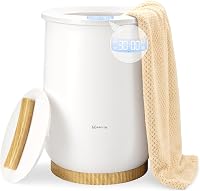
The VIPBATH 35L shows the middle of the field. Its 35 L interior warms 3 large towels or 2 robes, so a family can load it in one go.
The one-piece frame folds flat when you don't need it.
It also brings features the bucket doesn't have. A viewing window lets you check towels without lifting the lid, and the ETL-certified build shuts off on overheat and if the unit tips over.
The box includes 12 scented discs.
The folding frame is the real cost saver for some buyers. You get cabinet-level capacity but store it flat in a closet or behind a door.
That 35 L tub is nearly double the bucket's 20 L, so you're paying for real extra room, not a label. The front control panel keeps the settings within reach, and the fabric texture and wood-tone legs let it sit in a bathroom without looking like an appliance.
Those touches are what separate the mid-range from the budget end.
Is a folding warmer worth the extra?
For a family, yes. The VIPBATH folds flat in seconds and stores away, so it earns its mid-range place in homes where a fixed bucket would sit out all the time.
The 12 fragrance discs and the viewing window are extras you won't find on the cheapest tubs. If you live alone and only warm one towel, the extra capacity is capacity you won't fill.
What pushes the price up on wall-mounted racks?
Wall racks cost more than buckets because you pay for metal bars, mounting hardware and a wiring choice. The install itself can add a real chunk if you hire help.
The Regent 25.5-Inch is a good example of what the money covers. It's a 5-bar brushed nickel rack measuring 18.63 W x 5.25 D x 25.25 H, with all mounting hardware in the box.
Warmrails gives you two wiring routes: a 7-foot cord into a standard outlet or a hardwire connection to a junction box.
The 110-watt Filatherm dry element warms the bars in about 15 to 20 minutes. That's slower than a bucket, because the bars heat open air around the towel rather than a sealed tub.
The trade is space. A wall rack frees the floor and dries towels, swimsuits and delicates at once.
The Regent also carries cETL safety certification and can run day and night.
Wall-mounted models are also where the wiring decision hits your wallet. A hardwire job means an electrician, while the included cord means you can plug in and go.
The illuminated on/off switch is a small touch that matters in a dim bathroom, and the brushed nickel finish is the kind of material upgrade that lifts a rack above the basic models. The Regent is wall-mount only, so it won't stand on the floor as a backup.
Do you pay more to run a bigger warmer?
No. Running costs stay low across the whole category, and a bigger warmer doesn't mean a bigger bill.
The heating elements are small compared with most bathroom appliances.
The Regent's 110-watt element draws less power than a standard incandescent bulb. A bucket like the Keenray runs on a short 60-minute cycle with auto shut off, so it's only on when you need it.
A folding model like the VIPBATH adds tip-over shut-off and overheat protection, which keeps it safe to leave plugged in. Safety electronics don't add meaningful draw.
Your real running cost comes from how long you leave it on. A hardwired rack left on all day uses more than a bucket run for 20 minutes before a shower.
Most people turn warmers on before bathing and off after.
Warmrails says the Regent is built for continuous use and costs little to run, so leaving it on isn't a big spend. That's a comfort feature more than a cost one.
If you want warm towels on a schedule, the Regent has no built-in timer, so you'd plug it into a standard outlet timer.
What hidden costs should you plan for?
Installation, wiring and the odd accessory are the costs people forget. The warmer's sticker is only part of the total, and the extras vary a lot by model.
An electrician visit for a hardwire job is the biggest possible extra. A plug-in model avoids it entirely, so check the wiring options before you buy.
Mounting hardware often comes in the box. The Regent includes all of it, which saves a trip to the hardware store.
Fragrance discs, spare fuses and cleaning supplies are small costs. The VIPBATH includes 12 scented discs, so you won't buy those on day one.
If you rent, a freestanding bucket avoids landlord permission and wall repair. That's a cost saving as much as a convenience.
Check the care instructions too. The Keenray asks for hand washing only, so budget a little time rather than money for upkeep.
Which type gives you the best value?
A bucket gives the most warmth per dollar for one or two people, and a wall rack wins when floor space is tight. Pick by your household size and your bathroom layout, not by the brand.
For a single person or a couple, the Keenray CL1 covers the job. It holds two oversized towels and heats fast, with no install at all.
For a family that wants to load everyone's towels at once, the VIPBATH 35L fits more and folds away. Its 12 fragrance discs and window are nice extras at the mid-range price.
For a small bathroom where floor space matters, the Regent earns its cost. The 5-bar rack dries towels and garments at once and frees the floor.
Before you commit, read what size towel warmer do I need so you don't overpay for capacity you won't fill. If you're still unsure whether warmth is worth the spend, see what is the point of a towel warmer.
How much is a towel warmer once you factor in size and fit?
Budget by type first, then by capacity, and you'll land in the right range without overpaying. A 20 L bucket and a 5-bar rack can do the same job for one person, but the rack costs more and saves floor space.
Check that your towels fit before you buy. Can you put wet towels in a towel warmer covers what each type handles, so you don't pay for a warmer that can't take your bath sheet.
If you're weighing whether the warmth justifies the spend at all, do towel warmers work lays out what they actually do.
The simplest rule: buy the smallest warmer that holds your household's towels. A bucket for one or two people, a folding 35 L model for a family and a wall rack when floor space is tight.
That keeps the cost in line with the job, and you won't pay for capacity you'll never fill.
Frequently asked questions
How much is a towel warmer for a normal bathroom?
A bucket or small rack that holds one or two towels is the lowest-cost way in. Prices climb from there as you add capacity, a wall mount or a cabinet design.
Does a towel warmer cost much to run?
No. Small warmers draw very little power.
The Regent's 110-watt element draws less than a standard light bulb, so running costs stay small.
Do I need an electrician to install a towel warmer?
Only for a hardwired model. Many wall warmers plug into a standard outlet, and bucket warmers need no install at all.
What makes a towel warmer more expensive?
Bigger capacity, metal and stainless finishes, hardwire or dual wiring options, and extra safety features like tip-over shut-off and timers all push the price up.